
As a market researcher who always works to the highest standards and has decades of experience, I have witnessed and experienced the transformation of the industry at first hand. Qualitative market research is a dynamic industry; that’s another reason why I love my job. There have always been changes and there always will be.
Stagnation is regression. Society, framework conditions and markets are developing and changing, as are technology and its influence in the world.
In a world dominated by data and algorithms, it is paradoxical that qualitative market research is becoming increasingly important. As AI systems take over more and more analytical processes, the value of listening and gaining a deeper understanding of human motivations and behaviours is growing.
The moderation plays a central role in this.
‘The quality of qualitative research results depends directly on the quality of the input – and this is largely determined by the competence of the moderator. It makes the decisive difference – today more than ever.’
In my career, I have gained experience in moderating more than 6,000 group discussions and countless one-on-one interviews.
‘Qualitative research is not about what people do or say, but why they do or say it. We achieve this depth through the perfect balance of human empathy and technological support.’
__________________________________________________________
My approach therefore deliberately combines the strengths of traditional moderation and analysis with the possibilities of modern AI support and is a conscious integration of the best of both worlds:
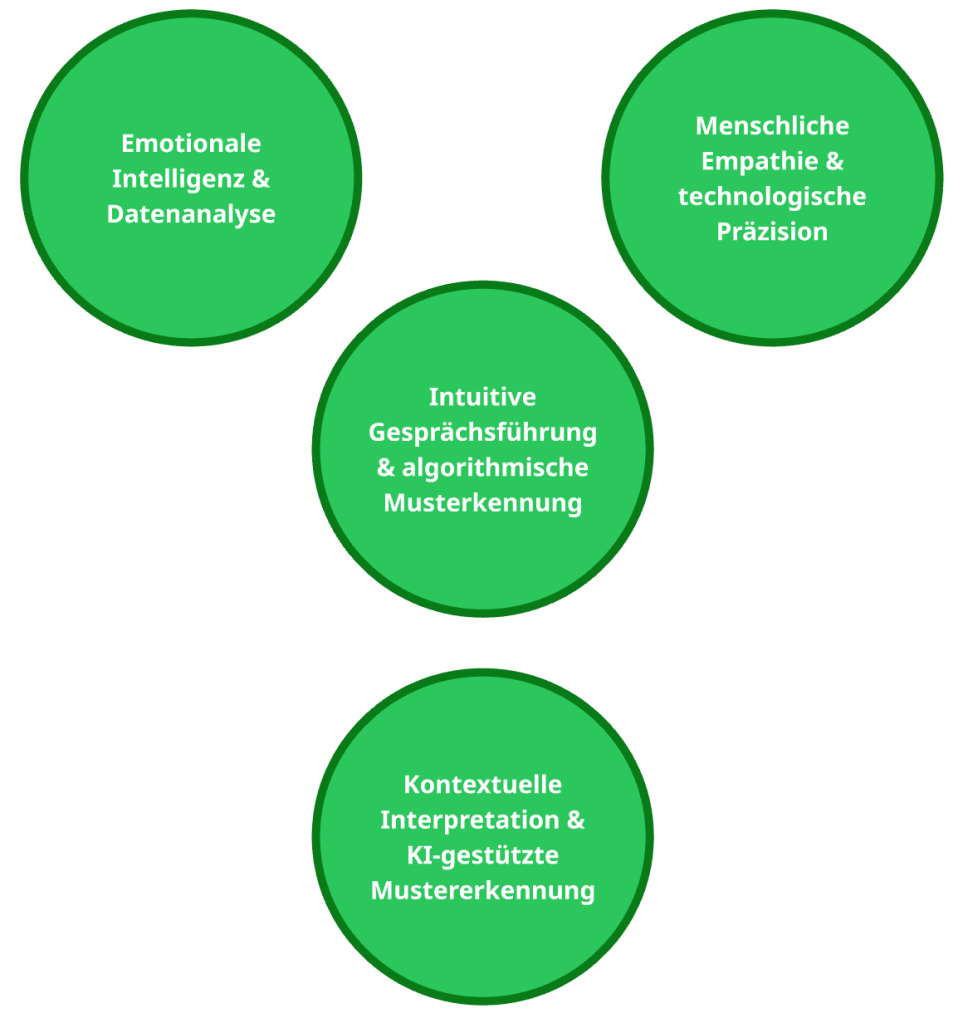
Specifically, this means…
- The art of empathetic listening: Recognising and taking into account the fine nuances in voice, facial expressions and body language, which often say more than words (a skill that no AI can fully replace).
- Dynamic conversation: The ability to adapt your conversation to the situation, to respond to unexpected turns of events and to recognise the right moment to ask more probing questions.
- AI as Co-Moderator: AI systems not as a replacement, but as a supplement – for example, for the real-time analysis of conversation patterns or the identification of overlooked topics.
- Hybrid methods of analysis: The combination of human interpretative skills with the scalability and speed of AI-supported data analysis.
- Contextual data interpretation: The ability to understand and interpret qualitative data in their cultural, social and situational context, complemented by AI systems that can identify hidden patterns and relationships across large amounts of data.
CONCRETE ADVANTAGES FOR YOUR PROJECTS
- Innovative combinations of methods that go beyond classic approaches
- Deeper insights into customer needs and motivations
- Reduction of unconscious biases through AI-supported objectivisation
- Faster results through efficient follow-up
 Naether Marktforschung